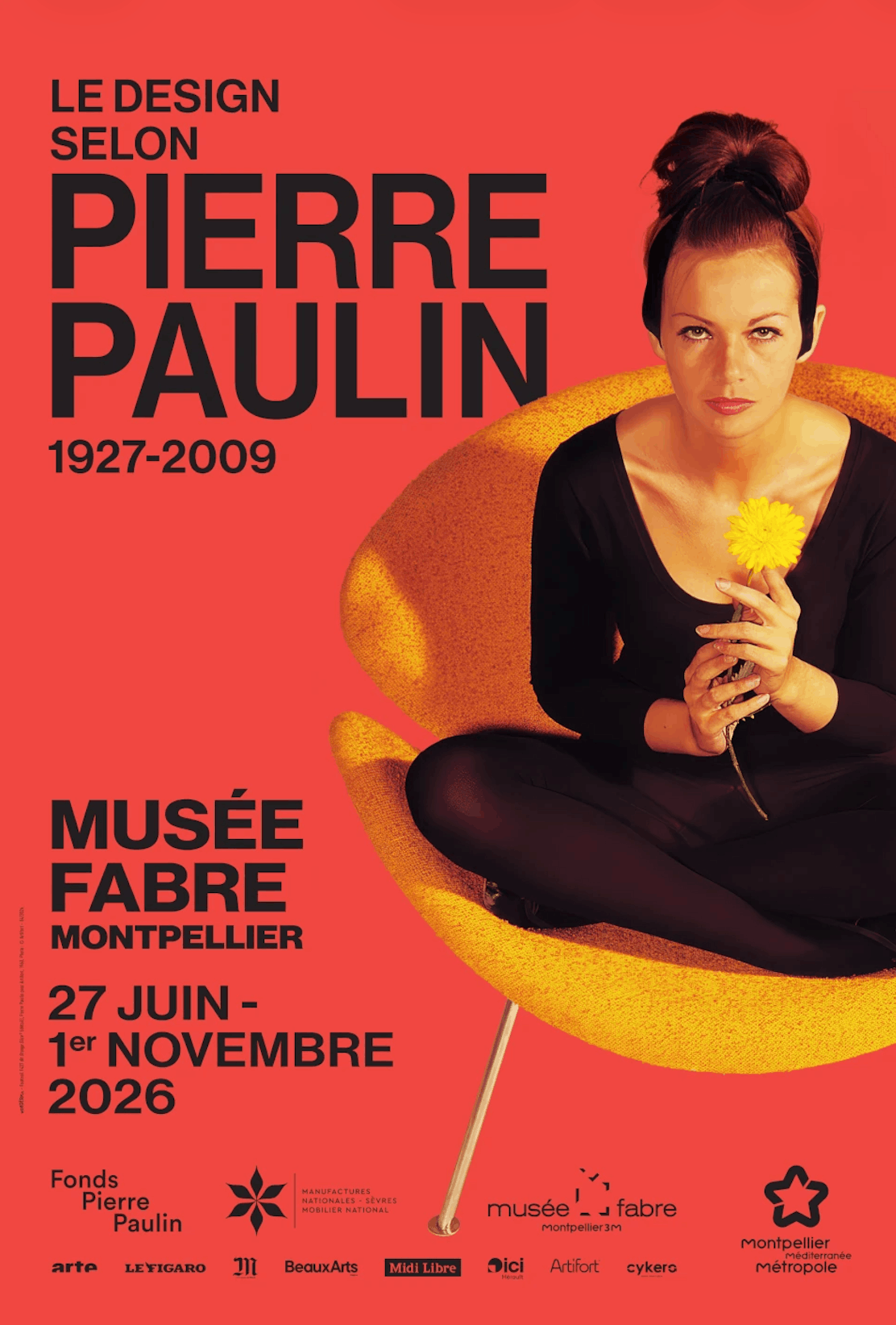
Design According to Pierre Paulin (1927–2009)
Visit the official websiteThe Musée Fabre in Montpellier is devoting a major exhibition to Pierre Paulin, one of the leading figures of 20th-century French design. Born in Paris in July 1927 and passing away in Montpellier in June 2009, Paulin profoundly influenced the history of contemporary furniture at a time when design was gradually establishing itself as a discipline in its own right in post-war France.
His most celebrated pieces, including the Mushroom Chair of 1959, the Ribbon Chair of 1966 and the Tongue Chair of 1968, remain icons of modern design today. They embody a new vision of comfort, form and use, while retaining a remarkable sense of contemporary relevance.
Pierre Paulin’s career unfolded against the backdrop of the Trente Glorieuses, a period of economic growth, technological optimism and profound social change. Attentive to the transformations of his time, he observed developments in Scandinavian and American design before developing a highly personal formal language. After creating furniture suited to the expectations of the 1950s, he began designing freer, softer seating in the 1960s, in tune with the rise of Pop culture and the new lifestyles of the baby-boom generation.
Produced by Meuble TV, Thonet Frères and later by the Dutch manufacturer Artifort, his designs quickly gained recognition at exhibitions devoted to domestic and decorative arts. As early as 1968, several of his pieces entered the collections of the Museum of Modern Art in New York, confirming the international recognition of his work.
In 1970, Pierre Paulin was selected by Claude and Georges Pompidou to redesign the private apartments of the Élysée Palace. This prestigious commission established him as one of the symbols of French modernity. Later, through the company ADSA, he broadened his practice to include industrial design, mass-market production and major public projects, affirming a comprehensive vision of the designer’s role.
During the 1980s, his work took a new direction. Paulin became increasingly interested in the permanence of styles, traditional craftsmanship, limited-edition pieces and a more direct relationship with nature. This line of thought feels particularly relevant today, anticipating contemporary concerns surrounding sustainability, use and the relationship between objects and their environment.
From 1992 onwards, he settled with his wife Maïa in the heart of the Cévennes, where he continued this exploration by gradually developing a property in which architecture, landscape and design entered into close dialogue. This chapter of his life reflects his ability to think about design beyond the object itself, as a way of inhabiting the world.
Over five decades, Pierre Paulin explored many dimensions of the designer’s profession: furniture, interior design, industrial design, public commissions, experimental pieces and more personal projects. Visionary, rigorous and deeply committed to use, he consistently regarded design as a discipline created for people.
Through a selection of major works, the exhibition at the Musée Fabre highlights the richness and singularity of Paulin’s career. It demonstrates the extent to which he contributed to renewing the forms, practices and imagination of French design, while continuing to question the place of design in everyday life.