
Within the landscape of French design in the 1950s, the name André Monpoix still remains relatively discreet — undeservedly so. A student of René Gabriel at the École des Arts Décoratifs in Paris, from which he graduated in 1949, he belonged to a generation shaped by the urgency of the post-war period.
Their ambition was clear: to design modern, accessible and rational furniture. A design language for reconstruction.
René Gabriel, a major figure in emergency furniture and at the Salon des Arts Ménagers, passed on a fundamental principle to his students: simplicity, economy of means and efficiency of use.
Monpoix retained from this approach a sense of formal restraint and a high level of constructive rigour.
The Salon des Arts Ménagers: a laboratory for modernity
During the 1950s, the Salon des Arts Ménagers was the essential showcase for contemporary furniture in France. It was there that a new generation came to prominence — Pierre Guariche, Alain Richard, Joseph-André Motte… and André Monpoix.
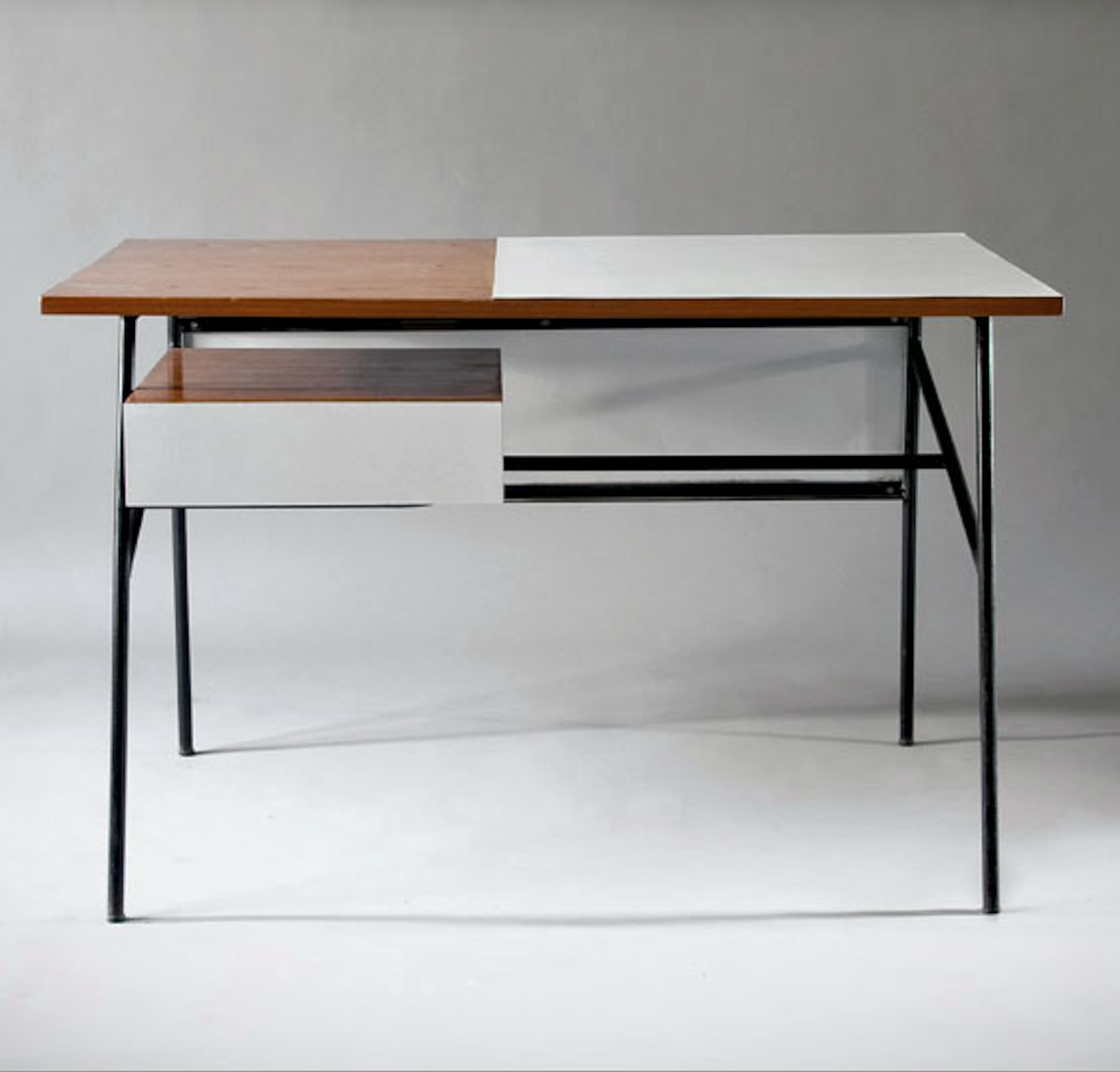
After working for four years alongside Jacques Dumond, Monpoix established his own practice in the early 1950s. In 1956, he presented at the Salon a desk produced by Meubles TV that attracted considerable attention.
At a time when solid wood still dominated bourgeois interiors, Monpoix boldly combined ash, Formica and a metal base. This dialogue between industrial and natural materials reflected changing lifestyles, with a growing emphasis on lightness, mobility and functionality.
The Meubles TV Desk: a discreet manifesto
The single-drawer desk is emblematic of his approach. A rectangular top with strictly orthogonal lines, carefully balanced proportions and a tubular lacquered-metal structure: every element contributes to a clear expression of function.
Formica, then strongly associated with domestic modernity, offered durability and ease of maintenance. The metal base visually lightened the overall structure while firmly placing the piece within an openly industrial design language.
This furniture is neither demonstrative nor spectacular. It is precise. Rational and balanced. Monpoix rejected unnecessary ornament in favour of the quality of the drawing and the equilibrium of volumes.
Meubles TV: an avant-garde manufacturer
Founded in the early 1950s, Meubles TV played a decisive role in the spread of modern design in France. The company quickly became an experimental platform for several major figures of post-war design.
Alongside Alain Richard, André Monpoix established himself as one of the company’s leading designers. Together, they contributed to the development of serially produced furniture conceived for industrial manufacture without compromising aesthetic standards.
Another notable piece by Monpoix is a lounge chair with a metal frame, its seat and back formed from stretched plastic cords — a bold technical experiment also presented at the Salon des Arts Ménagers in 1956.
A Design of Conviction
Like his contemporaries, Monpoix belonged to the so-called “young wolves” generation. They were all born between 1925 and 1930. All were trained in leading French schools. All shared the ambition of transforming the decorator into an interior architect.
Their mission: to invent the modern apartment. To create furniture suited to smaller living spaces. To develop solutions capable of being mass-produced while maintaining a high standard of design.
Within this movement, André Monpoix occupied a distinctive position: less prominent in the media than some of his peers, yet remarkably consistent in his formal language.
A Necessary Rediscovery
Long overshadowed by the better-known figures of the decade, André Monpoix’s work is now attracting renewed interest among collectors specialising in French design of the 1950s.
His pieces remain relatively rare on the market. They perfectly embody this transitional moment when French furniture gradually moved away from decoration and embraced industrial functionalism.
André Monpoix: Elegance Without Excess
Post-war design was not simply a matter of style. It was a response to a precise historical context: rebuilding, housing and furnishing.
André Monpoix’s Meubles TV desk does not seek to impress. It seeks to serve. And it is precisely this restraint that gives the piece such strength today.
Further Reading
- Mobilier National 1964-2004 : 40 ans de création: Réunion des Musées Nationaux (RMN), Paris, 2004.
Exhibition catalogue presenting public commissions and institutional interiors.
Useful for placing the designers of the reconstruction period — including Monpoix — within the context of French public policy. - VIA Design 3.0. 1979-2009 : 30 ans de création. Valérie Guillaume & Gérard Laizé. Éditions du Centre Pompidou / VIA, 2009.
Although focused on a later period, this publication places French designers within the broader continuity of post-war modernism.
Useful for understanding the legacy of the 1950s and the role of manufacturers in spreading modern design. - Design français 1950. La génération des jeunes loups
Éditions Pascal Cuisinier / Flammarion, 2015.
A key reference on the generation formed around Marcel Gascoin. It provides valuable information on the historical context, manufacturers such as Meubles TV, and the careers of André Monpoix, Alain Richard, Joseph-André Motte, Pierre Guariche and others. Essential for understanding Monpoix within his professional network.