
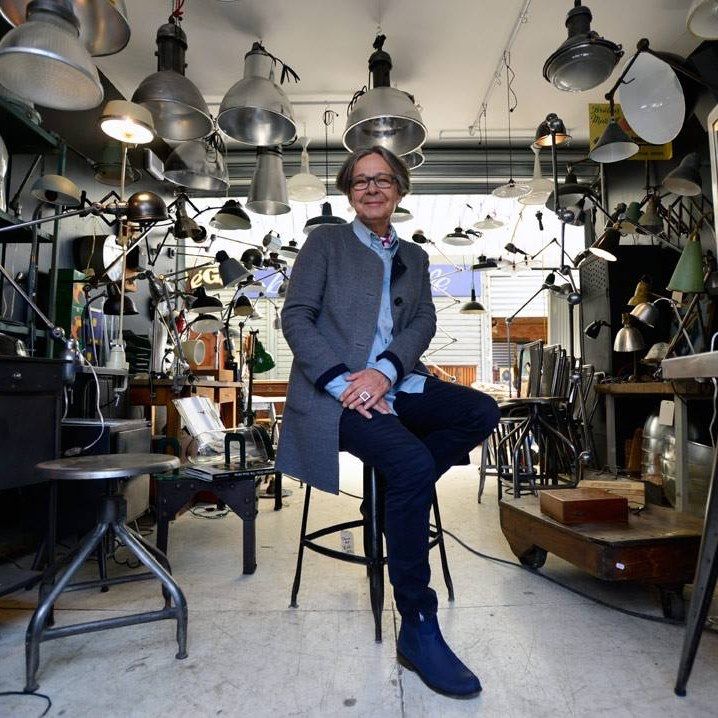
Le lien de Brigitte avec le métal remonte à son histoire familiale. « J’ai été élevée dans cet univers », résume-t-elle. Xavier Pauchard, son arrière-grand-oncle, est l’industriel bourguignon à l’origine de Tolix, marque déposée en 1927.
Ce fabricant de sièges et tables en métal est aussi le créateur de la chaise A, au milieu des années 1930. Un modèle empilable en tôle galvanisée, conçu avant tout pour être pratique, solide et bon marché… et devenu une silhouette familière. Elle s’installe aux terrasses des cafés, dans les ateliers, les parcs et les hôpitaux… avant de conquérir les intérieurs branchés au XXIe siècle.
De l’usine aux meubles du XVIIIe
Les petits fils de Xavier Pauchard -cousins de Brigitte - reprennent plus tard l’entreprise autunoise. « J’ai connu la maison de campagne où la famille se retrouvait pour passer la journée sur bord du lac des Settons » indique l’expert en mobilier industriel.
Bien entendu, les sièges de métal remplissent les lieux. « Mais ce qui est amusant, poursuit Brigitte Durieux, c'est que l’on retrouvait ce mobilier dans pratiquement tous les lieux de vie collectifs de la zone de chalandise. Je me souviens par exemple avoir fait des cures à la station thermale de Saint-Honoré-les-Bains, dans le Morvan. Du réfectoire aux dortoirs, toute la maison d'enfants était meublée en Tolix ! »
L’expert en design industriel aborde les rivages du marché de l’ancien grâce à sa grand-mère paternelle, « fan d’antiquités du XVIIIe siècle, elle était la plus fidèle des clientes des marchands d'Autun. À l’opposé, ma grand-mère maternelle s’inscrivait dans la modernité. »
Ambition contrariée
Ces trois angles de vue familiaux qui aiguisent sa « capacité à avoir une lecture de l’art au sens large » sont à l’origine de sa première vocation : « Lorsque j’étais au lycée, je voulais absolument devenir commissaire-priseur. Pour l’art en général… Mais aussi pour l’image de ce personnage avec un marteau ! s’amuse -t-elle. Ce qui me plaît d’un point de vue sociétal, c’est l’idée que l’objet ait plusieurs vies, qu’il voyage d’un château à un petit salon, qu’il soit transmis d’un amateur d’art à un autre. »
Toutefois, le chemin vers cette profession semble inaccessible. Brigitte est issue d'une fratrie de sept enfants : « difficile d’imaginer que mes parents puissent financer la formation nécessaire puis l’achat d’une charge ».
La jeune femme quitte finalement le Morvan pour suivre des études de lettres modernes à l'université de Bourgogne. Sa passion pour l’écriture et sa curiosité la mènent naturellement au journalisme.
Mix and match
En se mariant, elle découvre enfin la brocante « à travers les yeux du papa de (s)es fils. Et cet univers que je ne connais pas devient un art de vivre » : les moments de loisir s’organisent entre les circuits de motocross de ses trois fils… et les visites chez les marchands établis dans des granges ou hangars dans les villages. « Les manifestations à l’extérieur sont encore rares au début dans les années 1970-1980 ! »
L’appartement familial traduit évidemment cet amour pour les meubles et objets qui ont une histoire. « Je ne sais pas ce que c’est qu’un magasin de meubles neuf » concède notre interlocutrice chez qui, bien avant la tendance actuelle, la chaise Thonet cohabite avec l’armoire rustique du XVIIIe et le luminaire du XIXe siècle.
Esprit d’atelier
L’aménagement de la chambre de son fils aîné au début des années 1980 marque les prémices de sa fascination pour les accessoires et meubles venus de l’industrie. « Nous avons fait l’acquisition de tubes métalliques au magasin de bricolage pour fabriquer le lit et le bureau, accroché un tableau à trou pour suspendre des objets comme chez le garagiste. Nous avons aussi chiné une petite boîte à outils, afin de ranger ses crayons, une lampe Jieldé, une chaise d’atelier… Le tout repeint en rouge et noir. »
Il faut néanmoins attendre encore quelques années pour que Brigitte s’intéresse au patrimoine industriel, tout à fait par hasard.
« En 2004, on me demande une série de papier déco », raconte-t-elle. La journaliste travaille alors notamment sur Tolix. L’entreprise a connu des difficultés et vient d’être rachetée.
Suite à cet article, son compagnon issu du monde de l’édition l'encourage à poursuivre ses recherches pour assouvir sa curiosité. Le travail de ces industriels mérite effectivement d’être mis en lumière : « Ils ont réussi là où les créateurs n'ont pas pu réussir. Et pourquoi ? Parce que leur objectif c'est de vendre, et pour cela, il a fallu produire à des coûts raisonnables, donc simplifier les fabrications. »
Page blanche
L’historienne autodidacte se lance alors dans la rédaction d’lnoxydable Tolix. « Le livre est sorti l'année où les cafés branchés du Marais installaient des terrasses avec ces chaises en tôle. Il a été présenté comme expression de cette tendance et de l’intérêt pour le mobilier industriel qui émerge à l'époque ».
Le succès de l’ouvrage lui permet de continuer ses enquêtes sur d’autres pièces emblématiques. « En fait, rien n'avait été écrit sur les vestiaires d'usine, les lampes articulées, les sièges d’atelier. » Il lui faut donc beaucoup lire : « J'ai constitué une bibliothèque, relu la littérature de la fin du XIXe, mais aussi les auteurs des années 1970 qui s'étaient embauchés dans les usines ou encore les écrits sur la condition ouvrière de la philosophe Simone Weil… »
Du mobilier pliant utilisé lors des campagnes napoléoniennes aux petits lits installés sous les toits pour les vendeuses du Bon Marché décrits par Zola : « chaque fois que je voyais un mot en rapport avec le mobilier industriel dans un livre, je cochais le passage ».
Célébrer la mémoire collective
Une « vie monastique » que la journaliste complète par la recherche de fabriques toujours existantes, la rencontre d’anciens patrons ou des héritiers de marques comme Flambo, ou la chaise Nicolle…
En voyageant aussi en Europe, en Chine et aux États-Unis… « J'ai plein de souvenirs de gens délicieux, souvent d’un certain âge, que j'ai sorti de leur anonymat au moment où ils ne s’y attendaient pas. Je veux aussi rendre hommage à toute l'équipe du concept store Merci. Ces collectionneurs m’ont fait découvrir des choses qui m’avaient échappé. »
L’insatiable chercheuse n’en a pas fini avec ses investigations sur les créations du passé. Elle étudie la vie d’une nouvelle pièce emblématique, collabore avec des architectes sur des projets liés au patrimoine industriel et à la mémoire collective. Elle apporte fréquemment son expertise à des marchands pour identifier des objets.
La vie de commissaire-priseur lui a échappé ? Pas de regret, « finalement la vie m’a conduit là où je voulais aller. »
De l’ombre à la lumière
Les vieilleries que les brocanteurs jetaient avant les années 2000, sont tout d'un coup apparu, « grâce à l’obstination de marchands de L’ile-sur la Sorgue, comme Laurent Ardonceau. Préférant le métal au bois, la simplicité à l’ornementation, ils ont inventé l’ébénisterie métallique qu’on connait aujourd’hui. Ce phénomène culturel typiquement français s’est d’abord affiché dans les cafés du marais à Paris ». Il a connu différentes vagues : « des pièces à la présence forte, noires d’abord puis le design s’est épuré au fil des ans. » Les marchands ont découvert que l’on peut poncer pour mettre l’aspect métal en valeur. L’acier poli, puis patiné.
« Au bout d’une dizaine d’année, ces pièces de design ont fini par séduire le monde de l’art, les patrons des départements design. » La vocation utilitaire et sociale, les surfaces lices et l’absence d’ornement « rejoignent la démarche UAM (l’Union des artistes modernes fondée en 1929 promeut un art de vivre moderne, fonctionnel et accessible) », note la spécialiste. « La tendance s’impose comme un style. L’indus se découvre aujourd’hui à travers une sélection des plus belles pièces. »
En savoir plus :
- Inoxydable Tolix, par Brigitte Durieux, ed. La Martinière
- Le mobilier industriel, Quand l'utile devient style par Brigitte Durieux, ed. La Martinière
- Objets cultes du mobilier industriel par Brigitte Durieux, ed. La Martinière
Cécile Ybert