
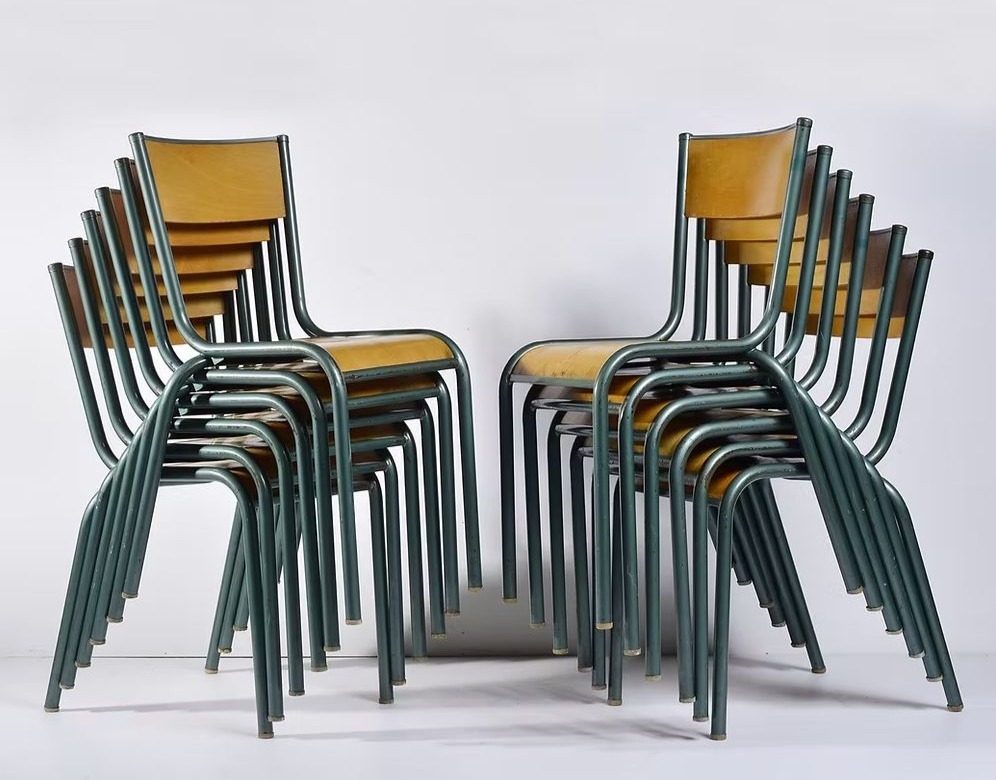
Gaston Cavaillon, former sales director of Compagnie Parisienne, filed the patent for the 510 in December 1964 on behalf of Mullca, the company he had co-founded in the post-war years.
Very early on, the company began using tubular steel to manufacture affordable seating, an approach that earned it orders from schools and the military. Among the flagship pieces in its catalogue were the Mullca 300, a children’s chair with armrests designed by Jacques Hitier in 1949, and the Mullca 511.
“The Ugliest Chair in the World”
Produced from 1950 onwards, based on a chair designed before the war, the latter proved extremely successful, particularly at a time when schools had to be furnished for the children of the baby boom. Its design was continually improved: the Mullca design office worked on protecting the edges of the plywood and reinforcing the structure.
The furniture had to withstand years of use by even the most restless pupils.
Despite its widespread success, the model began to feel dated by the mid-1960s.
On the website devoted to his father’s work, François Cavaillon recounts Eugène Claudius-Petit’s dislike of the aesthetics of the Mullca 511. In 1967, the former minister criticised the purchasing policy of the French Ministry of Education from the floor of the National Assembly, condemning its choice of “the ugliest chair in the world, on which every child in France will sit from the age of 2 to 18!”
Room for Improvement…
Fortunately, the company’s management had anticipated the need for change, and its catalogue already included the now-famous 510 model.
Years later, more than 12 million examples had been produced, and its silhouette had become permanently embedded in collective memory. Its success was rooted in its design. To create this icon of school furniture, Gaston Cavaillon and his design office set themselves a challenge: to do better… at a comparable price.
Like the 511, its simple frame was made from steel tubes bent under pressure and brazed together. But the lines were different: on the Mullca 510, the uprights of the backrest extend downwards to form the rear legs, whereas on the previous model, the backrest tube continues around the seat before becoming the front leg.
Its clean design was carefully considered down to the smallest detail to ensure remarkable durability, even under intensive use. The plywood panels are set into the metal frame, and the assembly — without screws or rivets — can withstand years of rocking by countless users… and even the occasional use of the chair as a projectile!
The seat is also strong enough to support the weight of a person standing on it.
Practical and Mobile
The company also highlighted a number of other advantages: the angle of the rear legs prevented the backrest from rubbing against and damaging walls, while the shape of the seat encouraged the user to sit upright.
Another major advantage for public institutions was mobility. The chair patented by Cavaillon in 1964 was relatively lightweight and stackable. This feature, already characteristic of the 511, was further optimised.
The model proved so successful that Mullca struggled to meet demand from schools. In 1973, the Union des groupements d’achats publics, which negotiated framework contracts with suppliers, requested a licensing agreement. Other manufacturers, including Lafa and Simire, subsequently began producing the 510.
From 1980 onwards, however, demand began to decline. The model’s exceptional durability limited the need for replacement, while the school population had stabilised. Expectations were also changing: the noise made by metal legs knocking together was criticised, as was the limited comfort of the chair during long school days… especially as the physical proportions of users had also evolved.
The 510 Enters the Home
In 1985, however, the chair began a new career in interior decoration when Habitat placed an order for versions finished in matte satin black.
Although Mullca eventually went bankrupt in the 1990s, the story continued. Lafa, which now holds the rights, resumed production for public institutions in 1996. The design of the 510 was adapted to meet contemporary ergonomic standards, with larger versions introduced. Welding, assembly methods and finishes were also modernised. Today, more than 26,000 examples in different sizes and colours leave the company’s factory in the Cantal region every year.
Since 2013, Label Édition has also marketed the “510 Originale”, faithful to the version originally conceived by Gaston Cavaillon. “I wanted to continue the spirit of Mullca,” explains Nicolas Girard, delighted to have brought renewed attention to the creator of this timeless chair, who until then had remained relatively little known. These affordable retro editions “are aimed at high-end interior design stores, restaurants and companies… and, somewhat surprisingly, are also exported from Denmark to Asia!”
For vintage enthusiasts and those nostalgic for their school days, flea markets and design fairs remain the ideal places to search for original examples whose youthful appeal seems timeless.
Cecile Ybert
The Market
“Collectors use this type of piece in the kitchen, as occasional chairs, or why not around a farmhouse table,” explains Julien Chamoux of Chez Cax - Brocante Vintage.
Their look, history and affordable prices appeal in particular to “young couples setting up home, although I have also sold sets to cafés and restaurants in Paris.” Most vintage examples can be found for between €30 and €70.
Find Out More:
- chaise-510.fr, to authenticate a chair and learn more about the history of Mullca.
- labeledition.fr, for the history of the brand and the company.