

"Les détails ne sont pas des détails : c'est ce qui fait le produit." — Charles Eames
Charles et Ray Eames ont profondément marqué l’histoire du design du XXe siècle par leur vision novatrice, aussi bien dans les formes que dans les matériaux. Leur travail continue d’inspirer les jeunes designers du monde entier.
1939 : Le début des recherches
Tout commence en 1939, lorsqu’ils participent à un concours organisé par Eliot Noyes, alors responsable design au MoMA. Leur projet, mêlant caoutchouc, contreplaqué courbé et métal, remporte le concours. Toutefois, la guerre freine le développement commercial de cette idée prometteuse. Les Eames poursuivent néanmoins leurs recherches, notamment pour l’armée américaine, en développant des atèles en contreplaqué. Cette période sera fondatrice de leur approche : utiliser la technologie pour créer des objets de haute qualité à moindre coût.
1948 : Un concours qui présage du succès
À nouveau grâce à l’initiative d’Eliot Noyes, les Eames participent à l’International Competition for Low Cost Furniture Design, lancé officiellement le 5 janvier 1948. Ce concours naît d’une inquiétude : face à la crise du logement, peu d’efforts sont faits pour concevoir un mobilier abordable, fonctionnel et esthétique.
Les designers sont donc encouragés à innover avec de nouveaux matériaux et méthodes de production. L’exposition finale est prévue au MoMA en 1949, et les modèles primés sont destinés à être commercialisés.
Le 18 janvier 1949, Nelson A. Rockefeller, président du MoMA, remet les prix et salue les contributions comme des avancées majeures pour la qualité de vie. Charles et Ray Eames, avec une équipe d’ingénieurs de l’UCLA, proposent une série de chaises en acier estampé. Ils remportent le second prix dans la catégorie sièges, ainsi qu’un prix de 2500 dollars.
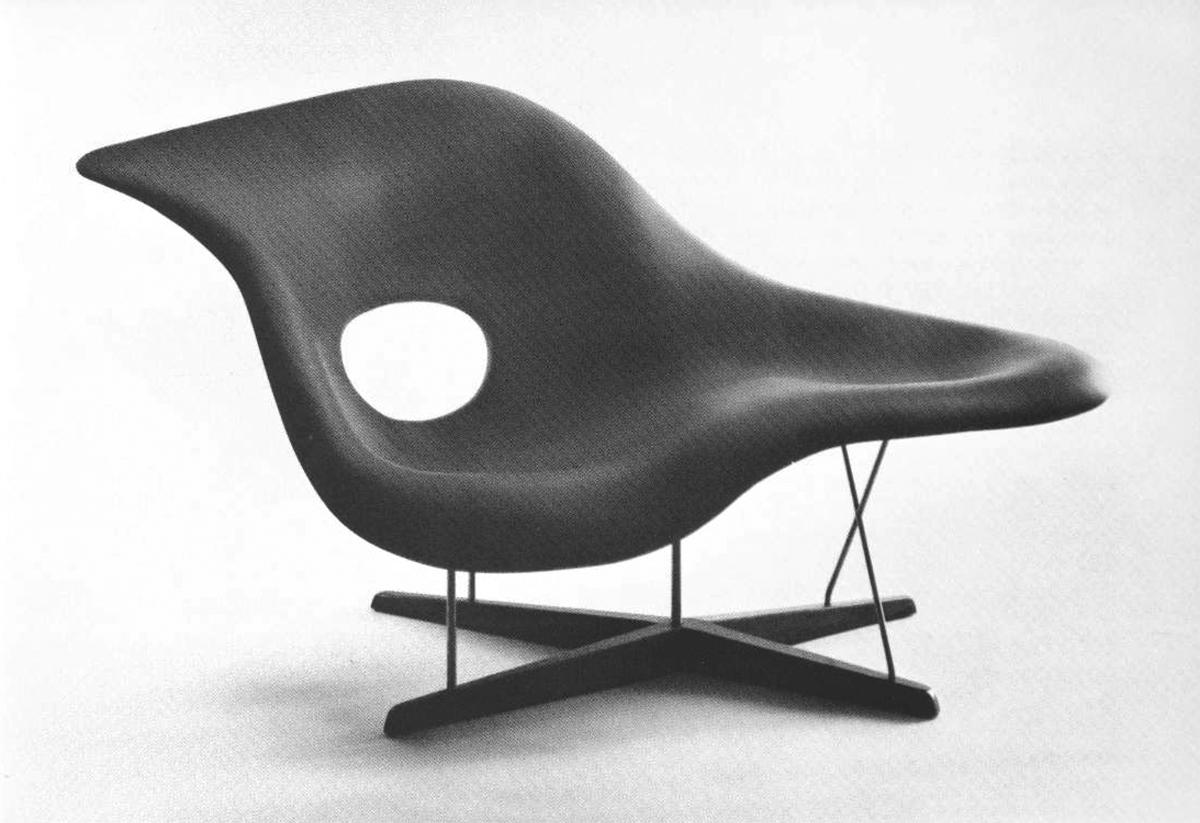
Ils soumettent aussi La Chaise, une méridienne inspirée de la sculpture Floating Figure de Gaston Lachaise (1927). Trop coûteuse et spécialisée, elle ne sera pas retenue mais reçoit une mention honorable pour sa beauté et son originalité.
1949 : Naissance de la première chaise en plastique apparent au monde
Les coûts élevés et la complexité de la production des chaises métalliques poussent les Eames à chercher d’autres solutions. Ils se tournent alors vers Zenith Plastic, entreprise spécialisée dans la fibre de verre, technologie issue de l’industrie militaire américaine.
En 1949, lors de l’exposition au MoMA, ils présentent ainsi le tout premier prototype de chaise à coque en plastique visible, fabriquée en résine moulée. Ce modèle précurseur ne sera toutefois édité qu’à partir de 1990, par Vitra.
1950 : Lancement de la production industrielle
Dès 1950, la production en série de fauteuils en fibre de verre débute, grâce à Herman Miller qui devient l’éditeur officiel. Les Eames collaborent avec Zenith Plastic pour adapter leurs modèles métalliques à la fibre de verre.
Charles rencontre Sol Fingerhut et Irv Green, chercheurs de chez Owens Corning, spécialisés dans la fibre de verre. Ensemble, ils résolvent deux problèmes techniques : fixer la base à la coque et traiter les bords. La solution ? Les fameux Schockmounts (ou « boutons ») pour l’assemblage, et une corde de chanvre — la rope edge — pour renforcer les arêtes, bien qu’elle soit finalement abandonnée pour simplifier la production.
Après plusieurs prototypes et nuits blanches, la coque moulée voit enfin le jour. Leur objectif est atteint : une chaise industrielle, ergonomique, produite à grande échelle à un prix abordable. La Eames Plastic Chair est née.
L'essor d’un mythe industriel
La Plastic Armchair et la DSS (Dining Stacking Chair) seront produites par Herman Miller puis Vitra, en millions d’exemplaires, avec une multitude de finitions et de piètements. Le siège à coque devient ainsi l’incarnation d’un mobilier moderne, accessible et intemporel.
Biographie et sources
- Walker Art Center (1950), Everyday Art Quarterly
- Smithson, Peter (1966), Architectural Design
- Holroyd, Geoffrey (1966), Chronological Table
- MoMA Press Release (1948), MoMA archive
- Neuhart, J., Neuhart, M. & Eames, R. (1989), Eames Design
- Time Magazine (1950), “Sympathetic Seat”
- McCoy, Esther (1975), Design Quarterly
- Morteo, Enrico (Éd.), Petite Encyclopédie du Design, Solar Éditions