
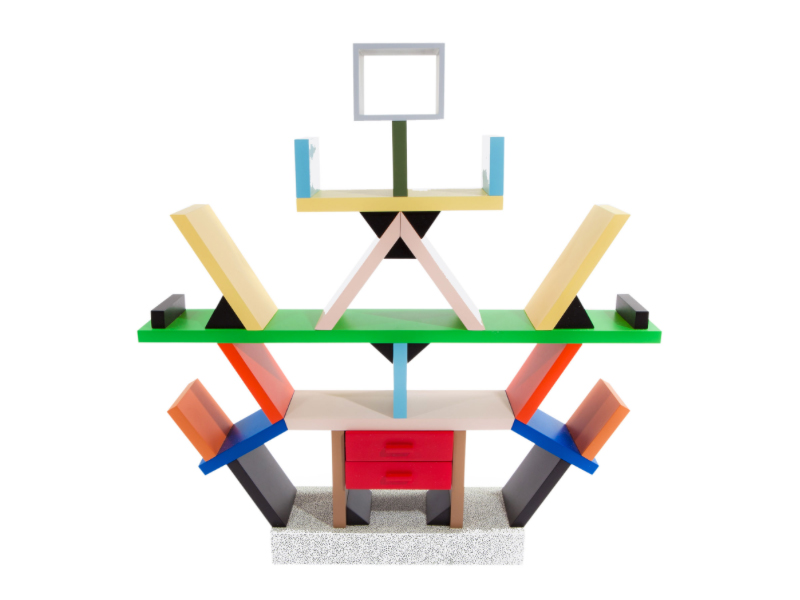
Memphis, Milan, 1981: A Historic Break
An explosion of colour, unconventional patterns and unstable geometries: when the Memphis group emerged in Milan in 1981, the design world was still largely dominated by the rigour inherited from the Bauhaus, the Ulm School and Nordic functionalism.
For decades, objects were expected to be rational, restrained and entirely devoted to function. With Ettore Sottsass as its central figure, a collective of young designers decided to break with this tradition. They combined inexpensive laminates and industrial materials with asymmetrical forms, vivid colours and references drawn from many sources — from Art Deco and popular culture to tribal imagery.
The effect was striking: the furniture seemed completely alien to established conventions, almost irreverent. Disconcerting to some and exhilarating to others, Memphis quickly established itself as an aesthetic and cultural provocation, emblematic of the shift that defined the 1980s.
The Day Milan Became Memphis
The story of the movement began almost by chance in Ettore Sottsass’s Milan apartment. Around him gathered a small group of young designers and artists, sharing ideas and projects. In the background, Bob Dylan’s Stuck Inside of Mobile with the Memphis Blues Again played repeatedly on the record player. From this coincidence came the group’s name: Memphis, evoking at once an American city, an ancient capital and a melancholic blues song.
For Barbara Radice, art critic and co-founder of the collective, this ambiguity was fundamental: somewhere between popular music and intellectual references, deliberate kitsch and mythological culture, Memphis chose to blur the boundaries.
A few months later, in January 1981, the Milan Furniture Fair became its inaugural stage. The public discovered pieces that seemed as much like artistic installations as domestic furniture: Sottsass’s Carlton bookcase, resembling a voodoo sculpture; George Sowden’s Antibes cabinet with its exaggerated proportions; or Peter Shire’s Bel Air armchair, worthy of a psychedelic cartoon.
Nothing was conventional, and nothing seemed designed primarily for immediate practical use — yet these creations fascinated. They attracted attention, raised questions, disturbed expectations and imposed an entirely new aesthetic, in complete opposition to modernist dogma.
A Design That Says No
For Ettore Sottsass, design was never merely a matter of style or decoration. It was a language, and even a political act.
Trained as an architect and deeply influenced by his travels in India, he had already challenged conventions through his work for Olivetti in the 1960s. The Valentine typewriter (1969), conceived as a colourful and portable object, made a lasting impression and is now part of major museum collections.
With Memphis, Sottsass went further: he transformed the object into a manifesto.
The group followed in the tradition of Italian Anti-Design, a movement that had developed from the late 1950s through radical collectives such as Archizoom, Superstudio and Radical Design, all of which criticised the austerity of functionalism and the illusions of consumer society.
Memphis adopted this criticism but expressed it differently: through play, colour and subversion. Here, aesthetics deliberately took precedence over function. Furniture was no longer merely useful: it became provocation, signal and statement.
It was a way of shaking up an everyday life considered too dull, while reminding people that design could also be a space for freedom and debate.
The Aesthetics of Shock
Memphis held nothing back: plastic, coloured laminates, Formica, laminated plywood… Far from seeking noble materials, the group embraced appropriation, accessibility and visual disruption. This paradox — drawing inspiration from luxury while using modest materials — became one of its signatures. References were mixed without hierarchy: Art Deco, Pop Art, comic books, Mayan architecture, African tribal art and 1950s American imagery.
Everything was placed on the same level and assembled with humour and irreverence. Furniture featured oversized legs, broken lines and endlessly repeated geometric patterns. As Barbara Radice, critic and co-founder of the group, summed it up: “The aim was to free design from the tyranny of good taste.”
A Brief but Decisive Revolution
Memphis lasted only six years, until 1987. Not because the movement had run out of ideas, but because, according to Sottsass, “you can only make a revolution once.”
Its creations quickly attracted prestigious admirers: Karl Lagerfeld filled his apartment with Memphis pieces, while David Bowie became a collector.
The wider public remained more cautious: the movement was too radical, too unsettling. Today, Memphis Milano continues to produce certain pieces in limited editions, and the movement has experienced a major revival since the 2010s. Its visual codes once again inspire fashion, graphic design, galleries and even digital design, occasionally echoed by brands such as Google, Apple and Spotify.
The Tahiti lamps, Casablanca cabinets and Kristall shelving units now achieve record prices at auction. Memphis is no longer seen as a passing eccentricity, but as a genuine gesture of freedom.
A brief cry of rebellion, it left a lasting mark: the legacy of a design movement capable of moving us as much as challenging us.
Achille