
At the Crossroads of Art and Industry
Born in 1926 in Lafayette, Indiana, Richard Schultz studied at Chicago’s New Bauhaus, the Institute of Design founded by László Moholy-Nagy. In this unconventional environment, he learned that creativity mattered just as much as technique, and that an object should be conceived as a complete experience. His education embraced a wide range of disciplines, from architecture and photography to graphic and product design.
This curiosity led him to join Knoll in 1951, one of the most innovative manufacturers in American design. His first assignment was to assist Harry Bertoia in the development of the Wire Collection. In Bertoia’s makeshift workshop, Schultz discovered metalworking as a form of sculpture, along with the importance of line and balance. This formative experience would influence his entire career: for Schultz, furniture had to breathe and engage with the surrounding space, almost like a living form.
The Functional Poetry of the Petal Table
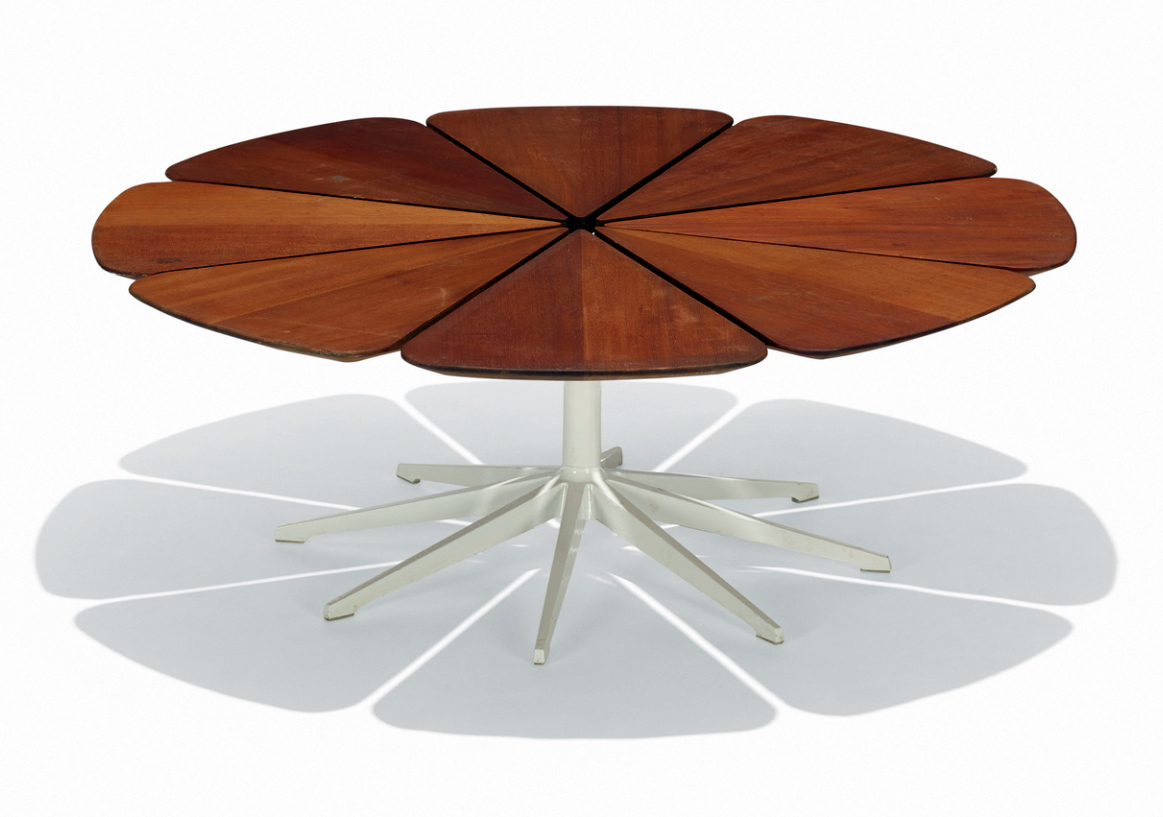
In 1960, Schultz created one of his most celebrated designs: the Petal Table. Inspired by the wildflower known as Queen Anne’s lace, it consists of eight independent surfaces attached to a central base, opening out like the petals of a flower. Each petal is able to expand or contract independently, ensuring stability and resistance to changing weather conditions.
Schultz explained: “My idea was to be able to look through the petals and see them floating, without seeing the structure.”
The table stands out for its visual lightness and technical precision. Recognised by Industrial Design Magazine, it is now regarded as one of the finest examples of functional poetry in 20th-century design.
With it, Schultz demonstrated that furniture could be both sculptural and perfectly suited to everyday use.
Outdoor Furniture Reinvented
The true revolution came in 1966. Living in Florida, Florence Knoll asked her designers to create furniture capable of withstanding sea air and humidity without sacrificing elegance. Schultz responded with the Leisure Collection, later renamed the 1966 Collection.
Armchairs, lounge chairs and tables made from aluminium and perforated metal replaced materials that deteriorated in harsh outdoor conditions. The result was furniture that was modern, ergonomic, durable and, above all, specifically designed for outdoor use — a groundbreaking approach in the history of design.
New York’s MoMA soon acquired several pieces, confirming the significance of this innovation. Schultz had opened up a new field: furniture capable of combining industrial technology with domestic comfort, redefining the art of outdoor living.
A Discreet but Consistent Designer
After leaving Knoll in 1972, Schultz continued working with other manufacturers before founding Richard Schultz Design in 1992 with his son Peter. His work remained true to his guiding principles: lightness, technical precision and formal poetry.
In the 1990s, the Topiary Collection — metal seating cut into patterns reminiscent of stylised foliage — reflected his ongoing search for furniture that was both functional and expressive. In 2010, the Fresh Air Collection pushed the limits of structural lightness even further.
In 2012, Knoll officially acquired his company, reissuing his iconic designs and cementing recognition of his contribution to modern design. Schultz, understated and largely removed from the spotlight, remained a highly respected figure for the consistency of his work and his ability to evolve his design language without ever abandoning its fundamental principles.
Legacy and Influence
In 2017, Wright Auction in Chicago offered part of his archive for sale, including previously unseen prototypes, early sculptures and designs that had never entered production. The sale shed new light on the full scope of his career, from artistic experimentation to industrial production.
Schultz is now widely recognised as a pioneer of modern outdoor furniture, but reducing his work to this field alone would overlook the breadth of his contribution. His approach embodies a sensitive minimalism in which technology never comes at the expense of emotion.
“The form must always remain legible. Even in a garden, a piece of furniture needs to breathe,” he once said. Balancing poetry and precision, Schultz created a distinctive design language whose influence can still be seen in contemporary design, from domestic interiors to urban terraces.