
Un projet de modernité intégrée
En 1956, la compagnie aérienne Scandinavian Airlines System (SAS) confie à l’architecte danois Arne Jacobsen une mission inédite : concevoir à Copenhague un complexe réunissant en un seul lieu terminal aérien, bureaux et hôtel de prestige. L’édifice, inauguré en 1960, devient le premier gratte-ciel de la capitale danoise et un manifeste de modernité.
Situé à proximité immédiate de la gare centrale, le bâtiment devait également répondre à un défi acoustique majeur : filtrer le vacarme des trains et du trafic aérien. Jacobsen imagine alors une tour sobre et imposante, pensée comme une barrière contre le bruit.
Mais son ambition dépasse la seule architecture : il conçoit un projet total, où chaque détail — mobilier, vaisselle, luminaires, poignées de porte — participe d’une même cohérence esthétique.
L’hôtel comme œuvre totale
Le SAS Royal Hotel illustre ce que l’on appelle une "Gesamtkunstwerk", une œuvre d’art totale. Pour Jacobsen, l’architecture n’est pas seulement un volume à habiter : c’est une expérience complète. Les circulations, les zones d’attente, les espaces de repos sont dessinés pour favoriser les rencontres, préserver l’intimité et atténuer l’austérité de la monumentalité moderne.
Cette approche fonctionnaliste, héritée du Bauhaus et de l’école d’Ulm, se teinte d’une dimension organique typiquement scandinave : la recherche de confort, de lumière, de chaleur dans un environnement rationnel.
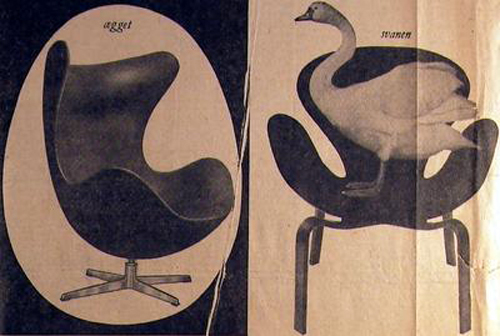
C’est dans ce contexte que naissent deux créations majeures, les fauteuils Swan et Egg, édités par Fritz Hansen, qui marquent l’histoire du design.
Le Swan et l’Egg : icônes sculpturales
En 1957, Jacobsen s’inspire des recherches de Charles et Ray Eames aux États-Unis et de Eero Saarinen en Finlande pour explorer de nouveaux matériaux.
Grâce au moulage de polyuréthane renforcé de fibre de verre, recouvert de mousse et de tissu, il donne naissance à des coques sans structure apparente, à la fois légères et enveloppantes.
Le Swan, avec ses accoudoirs déployés comme des ailes, évoque le mouvement gracieux d’un cygne. Lorsqu’ils sont regroupés, ces fauteuils suggèrent l’envolée d’un groupe d’oiseaux.
L’Egg, plus monumental, adopte une forme protectrice : son dossier haut et incurvé crée une bulle intime au cœur du hall d’hôtel, permettant à l’utilisateur de s’isoler visuellement et acoustiquement dans un espace public.
La fusion de la technique et de l’organique
Ces assises ne sont pas de simples objets décoratifs : elles traduisent la volonté de Jacobsen de fusionner rigueur industrielle et inspiration naturelle.
Leur forme libre aurait été impossible à réaliser avec les techniques traditionnelles du bois ou du métal. Grâce aux matériaux composites, Jacobsen atteint un équilibre inédit : un mobilier sculptural, fonctionnel et accessible, au service d’un nouvel art de vivre moderne.
Comme l’écrira plus tard Fritz Hansen, « le Swan et l’Egg ont été pensés pour être vus de tous côtés, comme des sculptures dans l’espace ». Leur force tient dans cette dualité : pièces de design et œuvres d’art.
Un héritage intemporel
Plus de soixante ans après leur création, le Swan et l’Egg restent produits par Fritz Hansen et s’arrachent dans les ventes aux enchères comme dans les intérieurs contemporains. Ils incarnent l’apogée de la carrière de Jacobsen, mais aussi la réussite d’un projet global où architecture, mobilier et expérience humaine dialoguent dans une vision cohérente.
Le SAS Royal Hotel a depuis évolué, mais la chambre 606, préservée dans son état d’origine, témoigne encore du génie d’Arne Jacobsen et de sa quête d’un design total.
Achille