
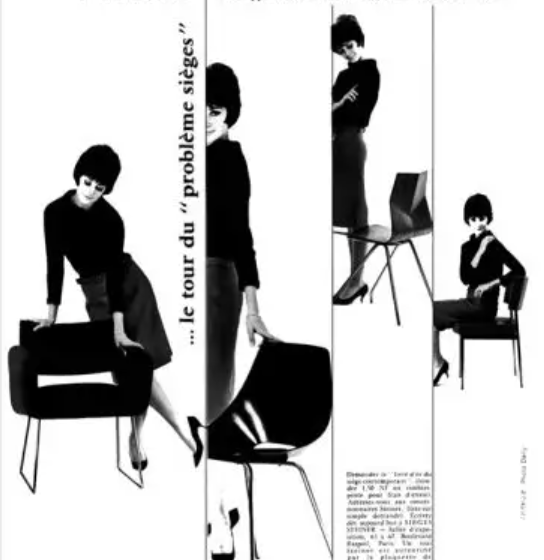
The Origins: From the Club Armchair to the Modernist Avant-Garde
In 1926, Charles Steiner founded his seating company in Paris’s Faubourg Saint-Antoine. His first models followed the Art Deco tradition and drew inspiration from the English club armchair — robust and comfortable — reinterpreted with more angular and geometric lines. By the late 1920s, Steiner had already begun moving towards modernism: the use of tubular metal in the Constance armchair of 1928 announced a new era.
After Charles Steiner’s death in 1948, his son Hugues took over the company and firmly positioned the brand within the modern movement. The Bow-Wood series, made from steam-bent wood and offered at an affordable price, responded to the needs of post-war society.
The 1950s: Steiner and the Leading French Designers
At the beginning of the 1950s, Steiner established itself as one of the first French manufacturers to place its confidence in a new generation of designers. Hugues Steiner understood that the future of furniture depended on innovation and collaboration with bold creative talents. He therefore worked with Pierre Guariche, who designed seating with taut, modern lines, including the Vampire armchair (1951), the Tonneau chair (1953) and the Corb armchair (1956).
In the same spirit, Joseph-André Motte developed a series of comfortable and practical seats, such as the 760 and 770 armchairs and the A6 tripod chair. René-Jean Caillette, meanwhile, created models with softer and more accessible forms, including the Coccinelle chair and the famous Diamant chair.
To give structure to this creative energy, Steiner set up the Atelier de Recherche Plastique (A.R.P.), a genuine laboratory of ideas that enabled the company to compete with innovations coming from the United States, represented by designers such as Charles Eames and Eero Saarinen.
The studio became a privileged field of experimentation for testing new materials — moulded plywood, resin shells and tubular metal — and for rethinking domestic comfort. Thanks to this strategy, Steiner became a standard-bearer of French design during the 1950s, capable of producing furniture that was at once aesthetic, innovative and accessible to the emerging post-war middle class.
The 1960s–1970s: Comfort and Futurism
During the 1960s, lifestyles changed and the living room became a true space for everyday life. Steiner adapted by developing modular and comfortable sofas, such as Michel Mortier’s Teckel.
The company also partnered with the Italian manufacturer Sedia in order to enter the office furniture market.
By the mid-1960s, Steiner embraced the wave of futuristic design. New materials — moulded plastic, jersey and synthetic fabrics — made freer and more colourful forms possible. Designer Kwok Hoi Chan embodied this period through a series of emblematic creations: the Kaïdo armchair (1966), the Pussycat chair (1968), the Zen armchair (1969), the Limande lounge chair (1971) and the Alligator armchair (1973).
These bold, organic and playful pieces marked the creative peak of the company.
Decline and the Legacy of a Major French Company
The late 1970s and the 1980s profoundly transformed the furniture industry: growing competition, declining purchasing power and the arrival of international brands such as IKEA.
Despite new proposals, including the Puma lounge chair by Yves Christin and furniture designed by Pierre Cardin, Steiner was no longer able to maintain its former position. In 1988, the company was acquired by Cauval Industries.
Today, Steiner continues to exist through reissues of its great classics, which remain highly sought after by collectors and vintage design enthusiasts. Its name remains closely associated with a period when French furniture boldly combined innovation, elegance and accessibility.
Bibliography
- Patrick Favardin, Steiner et l’aventure du design, Paris, Éditions Norma, 2010.
- Sièges en société : du Roi-Soleil à Marianne, exhibition catalogue, Mobilier national / Galerie des Gobelins, 2017.
- Les Trente Glorieuses : design français 1945-1975, exhibition catalogue, Musée des Arts décoratifs, Paris, 1995.
- Galerie Pascal Cuisinier, Les designers français des années 50, exhibition catalogues and monographs.
- Mobilier National, archives and online publications relating to Steiner, ARP and associated designers.