
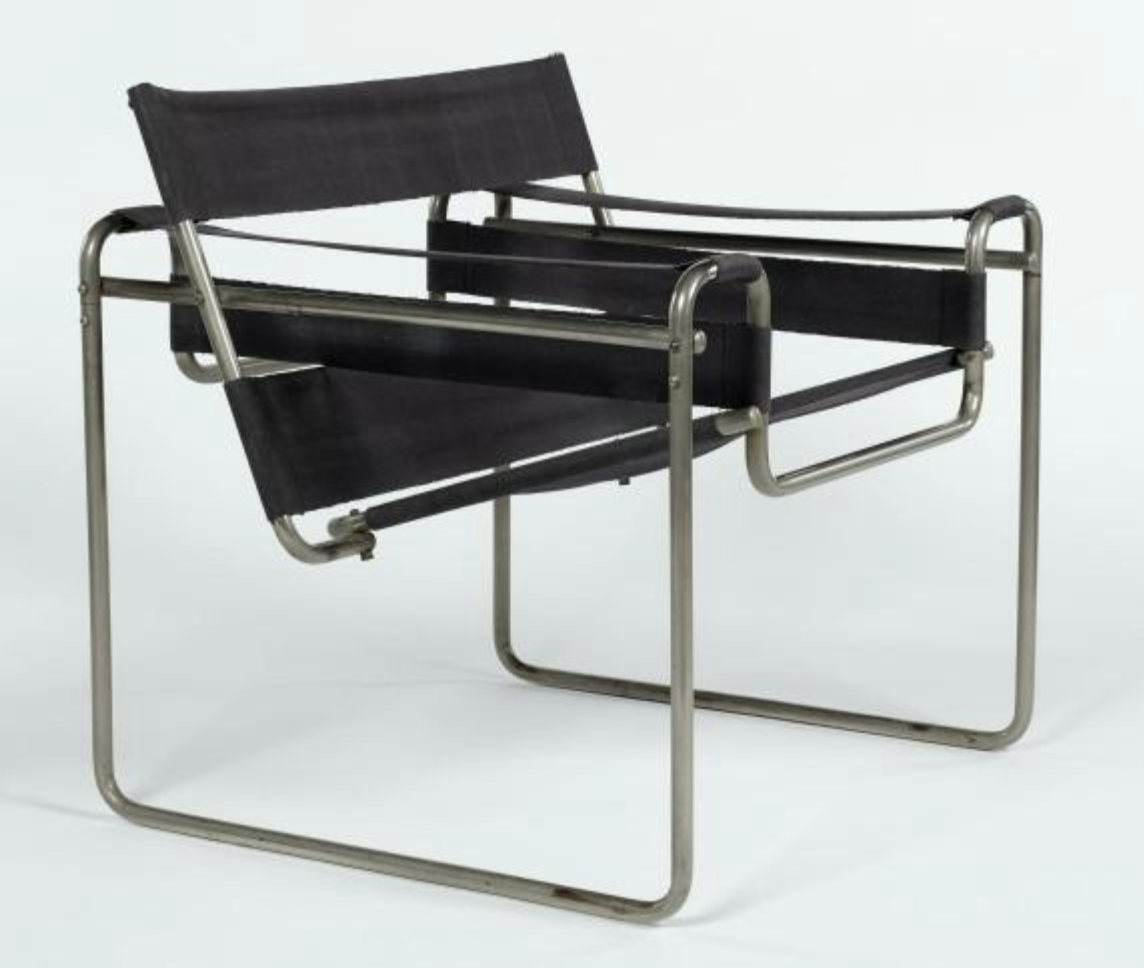
Né en Hongrie en 1902, Marcel Breuer suit une formation à l'Académie des beaux-arts de Vienne avant d’intégrer l’école du Bauhaus en 1920. L'établissement, dans lequel tous les métiers d’art sont invités à collaborer, aménage dans un bâtiment à Dessau cinq ans plus tard.
De jeunes diplômés sont alors promus maîtres. Reconnu pour son travail sur le bois, et encouragé par Walter Gropius qui dirige l’école, Marcel Breuer est nommé responsable de l'atelier de meubles au sein de cette institution d’avant-garde.
Avant le début de l’année scolaire, il réfléchit à l’utilisation de l’acier tubulaire dans l’univers du meuble. Pour la petite histoire, c’est sa nouvelle bicyclette Adler (plus exactement le tube d’acier de son guidon) qui déclenche son inspiration.
Les prémices du mobilier tubulaire
La réalisation du fauteuil doit beaucoup aux progrès techniques de Mannesmann, une entreprise allemande qui produit des tubes d’acier lisses et cintrés sans soudure apparente. Des années plus tard, amusé, Breuer se remémore les explications d’un collègue architecte : « on les courbe comme des macaronis ». C’est ainsi que germe l’idée d’en faire un meuble.
Le B3 se compose ainsi d'une structure carrée en tubes d'acier sans soudure disgracieuse. Assise, dossier et accotoirs : le châssis du B3 est équipé de bandes de tissus fixées de sorte que le corps de l’utilisateur ne soit jamais en contact avec le froid de l’acier.
Les tout premiers modèles sont réalisés avec un tissage en Eisengarn, un terme que l’on pourrait traduire par « fil de fer ». Il s’agit en fait d’un matériau en coton ciré brillant qui résiste très bien aux déchirures. Le fil développé au milieu du XIXe siècle a été amélioré par Margaretha Reichardt, elle aussi artiste textile du Bauhaus. Les éditions plus récentes sont quant à elles équipées de bandes en cuir ou en tissu.
Une sculpture dans l’espace
Inspiré du volume et du confort de l’incontournable fauteuil club avec son dossier bas et ses larges accoudoirs, le B3 est tout comme lui robuste et stable.
Différence majeure : sa légèreté, car il demeure facile à déplacer, mais aussi parce que sa conception propose une révolution esthétique.
« Le siège est l’élément le plus important de l’intérieur, revendique Marcel Breuer. C’est une sculpture dans l’espace ».
« Le designer recherche l’épure », commente Emmanuel Jourgeaud, marchand spécialisé dans les créations du Bauhaus. « Face à un Wassily, on a l’impression d’avoir un siège qui tient dans le vide. Marcel Breuer - comme Ludwig Mies Van Der Rohe à la même époque - invente les meubles flottants ».
Confort pour tous
L’objectif du créateur est de proposer un siège conçu pour la vie moderne, facile à reproduire en série et peu coûteux afin d’être accessible au plus grand nombre. Les B3 contribuent ainsi à lancer la production mondiale de meubles en acier tubulaire.
En 1926, le siège compte parmi les meubles du bâtiment du Bauhaus de Dessau lors de son inauguration. Il est aussi présenté au grand public lors d’une exposition à la Dresdner Kunsthalle. La simplicité défendue par les modernistes est aux antipodes de « la mode lourde et fleurie de l’époque », poursuit Emmanuel Jourgeaud. Cette proposition faite de matériaux industriels et de lignes dépouillées est jugée froide et peine à séduire son public.
L’industrie rechignant à s’engager, Marcel Breuer s’associe avec son compatriote et collègue Kálmán Lengyel pour créer Standard Möbel. La marque berlinoise fournit des modèles en acier ou aluminium tubulaire imaginés par les designers, puis Standard Möbel et son catalogue sont vendus au fabricant de meubles austro-allemand Thonet, en 1928.
Dans les années 1960, le design imaginé par Breuer intéresse Dino Gavina. Le fabricant italien acquiert la licence pour le fauteuil club B3 et le produit de 1962 à 1968 à Bologne, avec un succès mitigé.
Un hommage à Kandinsky
C’est à cette époque que cette version du club est rebaptisée « Wassily » pour des raisons marketing.
L’éditeur fait ici un clin d’œil à Vassily Kandinsky, lequel était aussi professeur au Bauhaus au milieu des années 1920. Le peintre apprécie alors tellement ce design novateur que Breuer lui en fait fabriquer un exemplaire. Knoll International a depuis repris le flambeau. L’entreprise italienne Fasem produit également des modèles dans les années 1980.
Du Museum of Modern Art de New York, au Vitra Design Museum, ces pièces emblématiques du Bauhaus sont aujourd’hui entrées dans les musées.
par Cécile Ybert
Les Tarifs !
Les prix du neuf sont loin de l’idée du meuble pour tous imaginé par le designer.
Pour les sièges de seconde main, comptez entre 500 et 900 euros pour la plupart des pièces Gavina ou Knoll.
Les modèles d’avant-guerre peuvent quant à eux dépasser les 10 000 euros.
Pour aller plus loin
- Marcel Breuer, un architecte du Bauhaus en France, un podcast de radiofrance.fr sur ce créateur à la carrière internationale.
- Le Bauhaus, une école d’enseignement artistique ancrée dans l’histoire de l’art du XXe siècle qui fait la synthèse des arts plastiques, de l’artisanat et de l’industrie. Présentation du mouvement réalisée pour l’expo du MAD, en 2017.
- Le Musée du Bauhaus à Weimar a été inauguré en 2019, à l'occasion du 100e Anniversaire du mouvement. Il permet de découvrir l’histoire de ce mouvement révolutionnaire et les collections d’objets et meubles de la vie quotidienne.1, Stéphane-Hessel-Platz, à Weimar
- Emmanuel Jourgeaud : 5-element.fr
Repérez les modèles officiels
Nombre de copies frauduleuses circulent.
Comme à l’accoutumée, les prix trop bas doivent vous alerter.
Pour Emmanuel Jourgeaud, « pour reconnaître une édition officielle, il suffit souvent de s’asseoir dessus ! » Les modèles authentiques se distinguent par leur qualité : des extrémités soigneusement soudées, une structure robuste, stable et confortable. « Elles sont aussi plus lourdes que les copies », poursuit le marchand.
Enfin, les modèles récents portent fréquemment des indications : Knoll estampille et numérote ses fauteuils. Un comble pour « des pièces pensées avec la philosophie du Bauhaus », note Emmanuel Jourgeaud.
Les B3 anciens révèlent un marquage à chaud à l’arrière du cuir et depuis 1995, la signature de Marcel Breuer et la marque sont gravées dans la structure et une étiquette est collée sous l’assise. Les modèles Facem et Gavina présentent aussi des étiquettes et le cuir de Gavina est estampillé.
Cécile Ybert