
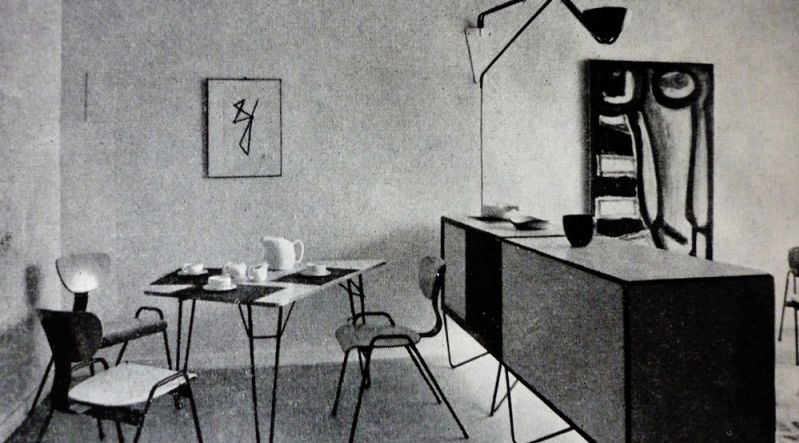
Chez Van Der Meeren, la forme ne cherche jamais à séduire. Elle découle d’un usage précis, d’une économie de moyens et d’une logique industrielle assumée. Son mobilier s’adresse d’abord aux écoles, aux logements sociaux et aux équipements collectifs, bien avant d’entrer dans les intérieurs privés.
Mobilier en série, pensée rationnelle
Dès le début des années 1950, Willy Van Der Meeren collabore avec l’éditeur belge Tubax (1951-1958), spécialisé dans le mobilier métallique. Il y développe des meubles à la structure apparente, combinant acier peint et panneaux de bois ou de contreplaqué standardisés, conçus pour être robustes, économiques et faciles à produire.
Parmi ses créations les plus emblématiques figure une armoire scolaire dessinée en 1952 : un meuble sobre, strictement fonctionnel, pensé pour l’usage intensif des établissements publics.
Dans le même esprit, il conçoit des chaises en métal laqué, aux assises et dossiers en bois recouverts de matériaux synthétiques, privilégiant la solidité, l’empilabilité et la facilité d’entretien.
Modularité et adaptabilité
Van Der Meeren s’intéresse très tôt aux systèmes modulaires. Tables, rangements et assises sont conçus pour s’adapter aux espaces et aux usages, dans une logique de flexibilité avant l’heure.
Certaines de ses tables, parfois regroupées sous des appellations tardives comme « Tangram », reposent sur un principe simple : permettre plusieurs configurations à partir d’un nombre réduit d’éléments standardisés.
Ce travail sur la modularité traduit une conviction forte : le mobilier doit accompagner les évolutions de la vie quotidienne, et non les contraindre.
Un designer engagé
Au-delà du meuble, Willy Van Der Meeren est un acteur majeur du logement social en Belgique. Il collabore notamment avec Léon Palm sur des projets de maisons préfabriquées destinées à répondre à l’urgence de l’après-guerre.
Là encore, son approche est guidée par la même éthique : rationaliser la construction, réduire les coûts, améliorer les conditions de vie.
Discret mais profondément influent, Van Der Meeren incarne une modernité sans effets de style, où le design est avant tout un outil au service de la société.
Références documentaires :
Willy Van Der Meeren, Mil De Kooning, Vlees en Beton n° 21-24/1993 (DUTCH).
Willy Van der Meeren: MASS, Peter Swinnen/Anne Judong. Leipzig October, 2025. ISBN: 9783959059282
Achille